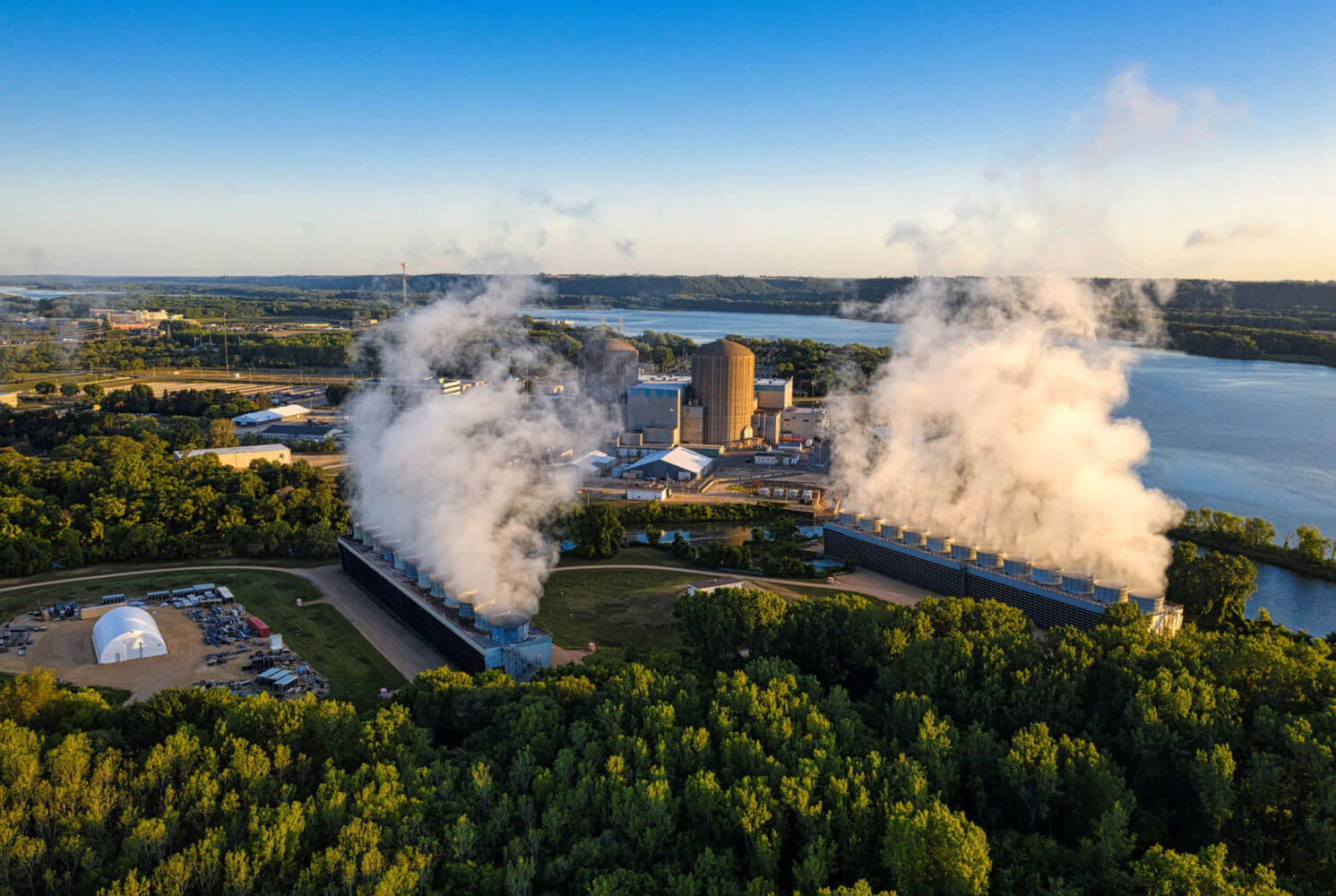
Factory emissions
Overview

Scope 1, 2 and 3 Emissions: Key Facts at a Glance

  • Framework origin: The Greenhouse Gas (GHG) Protocol groups corporate emissions into three scopes to distinguish direct and indirect emissions along the value chain.
  • Scope definitions: Scope 1 covers direct emissions from sources a company owns or controls, Scope 2 covers indirect emissions from purchased energy, and Scope 3 includes all other indirect emissions upstream and downstream.
  • Scope 3 dominance: For many companies, Scope 3 emissions account for 70–90% of the total carbon footprint, which makes them critical for net zero strategies.
  • Regulatory expectation: Regulators and investors increasingly expect complete coverage of Scope 1, 2 and 3 emissions as the basis for credible decarbonization plans.

The Scope Framework: Origins and Purpose

The Scope 1, 2 and 3 framework is central to calculating a company’s Corporate Carbon Footprint (CCF), which measures greenhouse gas (GHG) emissions associated with its operations and value chain. Defined by the GHG Protocol, the three scopes distinguish between direct emissions, emissions from purchased energy, and other indirect emissions across the value chain. Reporting frameworks such as the Corporate Sustainability Reporting Directive (CSRD), the UK’s Streamlined Energy and Carbon Reporting (SECR), and other standards worldwide build on this approach, although their disclosure requirements differ.

The scope concept originates from the GHG Protocol’s Corporate Accounting and Reporting Standard, developed by the World Resources Institute (WRI) and the World Business Council for Sustainable Development (WBCSD). First released in 2001 and revised in 2004, it established a common, internationally recognized method for companies to measure, manage, and report their GHG emissions.

By classifying direct and indirect emissions into three scopes, the framework helps prevent double counting within a company’s GHG inventory and provides a consistent basis for regulatory reporting, voluntary initiatives, and assurance. Today, it also supports climate target setting, including science-based targets.

What Are Scope 1 and Scope 2 Emissions?

Scope 1 covers the emissions a company causes directly, while Scope 2 covers the emissions behind the energy it buys.

Scope 1: Direct Emissions

Scope 1 emissions are direct GHG emissions from sources that a company owns or controls. They arise from activities where the organization directly burns fuel or releases greenhouse gases. Typical sources include:

  • Stationary combustion: Boilers, furnaces, or combined heat and power plants
  • Mobile combustion: Company-owned cars, trucks, forklifts, or construction machinery
  • Fugitive emissions: Refrigerant leakage or gas infrastructure
  • Process emissions: Chemical or physical processes in industries such as cement or steel

Because Scope 1 emissions are under direct operational control, they are often easier to measure and reduce through efficiency improvements, fuel switching, or process optimization.

Scope 2: Purchased Energy

Scope 2 emissions are indirect GHG emissions from the generation of purchased or acquired electricity, steam, heating, or cooling that a company consumes. They occur at the energy supplier’s facilities, but the company’s demand for energy drives them. Key characteristics include:

  • Location: Closely linked to the operational footprint but occurring off-site
  • Drivers: Dependent on both energy consumption and the emission factors of the grid or supplier
  • Two reporting methods: The location-based method uses the average emissions intensity of the regional grid, while the market-based method uses contractual instruments such as renewable energy certificates (RECs), guarantees of origin, or power purchase agreements (PPAs)

Examples include electricity for production lines and data centers, district heating for offices, or imported steam for industrial processes. Reductions usually combine efficiency measures with a shift to low-carbon or renewable energy.

What Are Scope 3 Emissions?

Scope 3 emissions cover all other indirect GHG emissions that occur in a company’s value chain, outside its direct control but linked to its activities. This includes both upstream impacts (suppliers and inbound logistics) and downstream impacts (customers, distribution, and end-of-life).

For many sectors, Scope 3 emissions represent the majority of the carbon footprint, often between 70 and 90%. They include, for example:

  • Purchased goods and services: Extraction and processing of raw materials
  • Upstream transportation: Transport and distribution by third-party logistics providers
  • Operations: Business travel, employee commuting, and waste generated in operations
  • Use phase: Energy consumption when customers operate a company’s products
  • End of life: Treatment and recycling of products and packaging

To structure these value chain emissions, the GHG Protocol defines 15 Scope 3 categories, grouped into eight upstream and seven downstream categories. Together, they show how products and services create emissions before, during, and after they leave a company’s facilities. Because Scope 3 emissions depend on supplier data, product design, and customer behavior, they are the most challenging to measure, but they also offer the biggest levers for meaningful climate action.
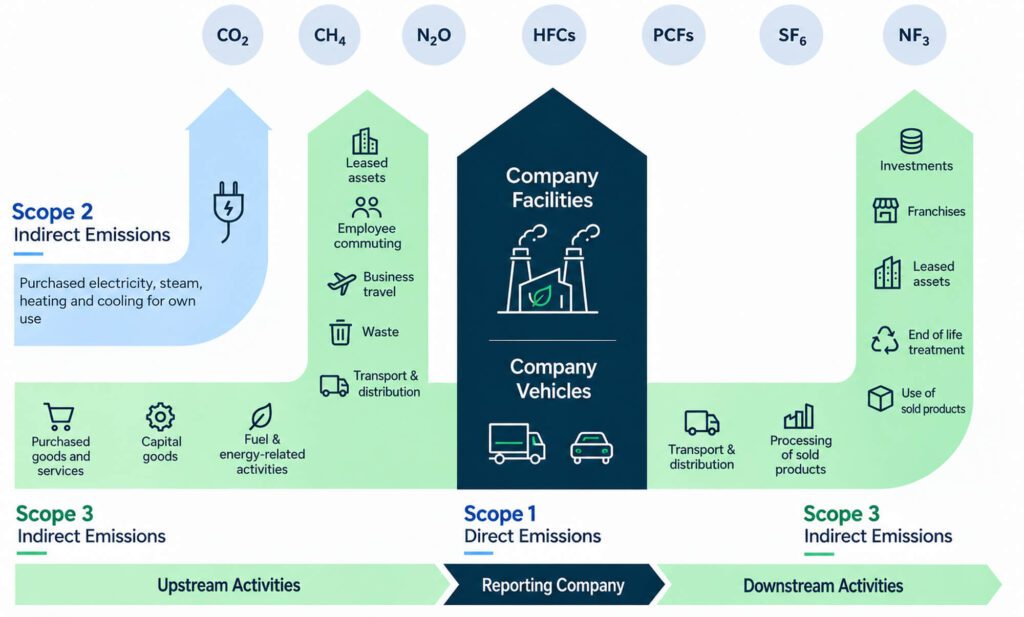
Scope 1, 2, 3 scheme

Carbon Footprint Software

See how Assent helps companies calculate and report carbon footprints across Scope 1, 2 and 3 with supplier data and audit-ready documentation.

Measuring Scope 1, 2 and 3 Emissions: Why and How

Measuring emissions across all three scopes turns the framework into numbers that people can act on. The following sections explain why complete coverage matters and how the calculation works.

Why Measure All Three Scopes?

Measuring only direct emissions no longer reflects how regulators, investors, and customers view climate risk. For any organization pursuing net zero, a complete carbon footprint across Scope 1, 2 and 3 is the starting point: it helps identify hotspots, prioritize reduction measures, and show that a climate strategy rests on robust data rather than estimates. A complete approach delivers:

  • A comprehensive view of climate impact: Companies see where GHG emissions really occur, often far beyond their own factory gates, and can focus on the most material hotspots.
  • Regulatory compliance: The CSRD requires companies to report material Scope 1, 2 and 3 emissions in their sustainability statements. Other regimes, such as SECR in the UK, focus on Scope 1 and 2 but increasingly expect relevant Scope 3 transparency as best practice.
  • Science-based targets and net zero: Initiatives such as the Science Based Targets initiative (SBTi) require companies to include Scope 3 emissions in their targets when these represent a significant share of the total footprint. Robust Scope 3 data gives net zero commitments across all scopes their credibility.

How Do Companies Measure Scope 1, 2 and 3 Emissions?

Corporate carbon footprints and carbon accounting across all three scopes typically follows five steps:

  • Define boundaries: Decide which entities and activities are included, for example based on operational control or equity share, and assign emission sources to the correct GHG Protocol scope.
  • Identify sources and Scope 3 categories: Map operations and the value chain to find the categories that are relevant and likely to be material.
  • Collect activity data: Gather data on energy, fuel, purchased goods and services, logistics, business travel, and product use. Where primary data is missing, use recognized emission factors and high-quality secondary data aligned with the GHG Protocol and ISO 14064.
  • Calculate emissions: Apply GHG Protocol or ISO 14064-compliant methodologies to convert activity data into CO2e (carbon dioxide equivalents).
  • Analyze hotspots and improve over time: Identify major emission sources, validate data quality, and update the inventory regularly as data coverage and quality improve.

How Can Companies Reduce Emissions Across All Scopes?

Once companies have quantified their Scope 1, 2 and 3 emissions, the next step is targeted reduction. The measures differ by scope:

  • Scope 1: Improve process and building efficiency, electrify heat and fleets where feasible, switch to lower-carbon fuels, and reduce fugitive emissions through leak detection and maintenance.
  • Scope 2: Implement energy management systems, invest in efficiency upgrades, and procure renewable energy through on-site generation, PPAs, or credible certificates.
  • Scope 3: Embed climate criteria in procurement, favor low-carbon materials and suppliers, redesign products for lower use-phase emissions and longer lifetimes, optimize logistics networks, and develop circular models to reduce end-of-life impacts.

A credible decarbonization roadmap combines reduction measures across all scopes and links them to clear targets, budgets, and responsibilities.

FAQ: Scope 1, 2 and 3 Emissions

Get expert insights on Scope 1, 2 and 3 emissions from Assent’s team of regulatory experts.

What are Scope 1, 2 and 3 emissions?

Scope 1 covers direct emissions from owned or controlled sources, such as fuel combustion. Scope 2 covers indirect emissions from purchased electricity, steam, heating, and cooling. Scope 3 covers all other indirect emissions upstream and downstream.

Why is Scope 3 so important?

Scope 3 emissions often make up the majority of a company’s carbon footprint, especially with complex supply chains or high use-phase emissions. Without them, net zero targets and science-based commitments remain incomplete.

What are the 15 Scope 3 categories?

The GHG Protocol defines 15 Scope 3 categories: eight upstream (purchased goods and services, capital goods, fuel- and energy-related activities, upstream transportation and distribution, waste generated in operations, business travel, employee commuting, upstream leased assets) and seven downstream (downstream transportation and distribution, processing of sold products, use of sold products, end-of-life treatment of sold products, downstream leased assets, franchises, investments).

How do I measure my company’s carbon footprint?

Define your boundaries, map your emission sources, and collect activity data on energy, fuel, purchases, logistics, and product use. Then calculate emissions in CO2e with the GHG Protocol or ISO 14064.

Is Scope 3 reporting mandatory?

Under the CSRD and similar frameworks, companies must report material Scope 1, 2 and 3 emissions, which in practice includes Scope 3 for most industries. Regimes such as SECR in the UK formally focus on Scope 1 and 2 but increasingly expect relevant Scope 3 disclosure.

How can software help with carbon accounting?

Digital carbon accounting tools integrate primary data from suppliers and internal systems, automate calculations, and deliver CSRD-ready reporting.

Simplify Scope 1, 2 and 3 Reporting With Assent

Learn more about how Assent can help you manage Scope 1, 2 and 3 emissions and your wider supply chain data across product compliance and ESG.