

Still Exploring?
Looks like you’ve been exploring our platform.
Want to see everything in one place?

A PCF quantifies the climate impact of one specific product, from a single component to a finished vehicle. It covers the greenhouse gas (GHG) emissions from raw materials, production, and transport, and optionally use and disposal. Customers, regulators, and sustainability reports increasingly rely on this figure, so companies calculate it according to recognized standards.
Three standards are best known for calculating a PCF:
ISO 14067 applies to all products and is the most common choice. The GHG Protocol standard is designed to work together with the Corporate and Scope 3 standards of the same protocol, and PAS 2050 is the British method it builds on.
Unlike a PCF, a corporate carbon footprint covers the emissions of a whole company across Scope 1, 2, and 3 over a set period, usually one year. Supplier PCFs improve the Scope 3 data in a buyer’s corporate footprint, because they replace estimates with measured values. Together, the corporate footprint shows where a business emits, and PCFs show which products drive those emissions.
Product-level emission data shows what company-level totals hide. The main benefits include:
A product carbon footprint shows the biggest emission hotspots and guides targeted reduction measures. Common strategies include:
Companies calculate the carbon footprint of a product by assessing all GHG emissions across its life cycle. The result is the sum of activity data multiplied by emission factors, expressed in CO2e. The established standards follow the same four steps as a life cycle assessment (LCA): defining goal and scope, collecting inventory data, assessing the impact, and interpreting the results. The only difference is that a PCF assesses a single impact category, climate change.
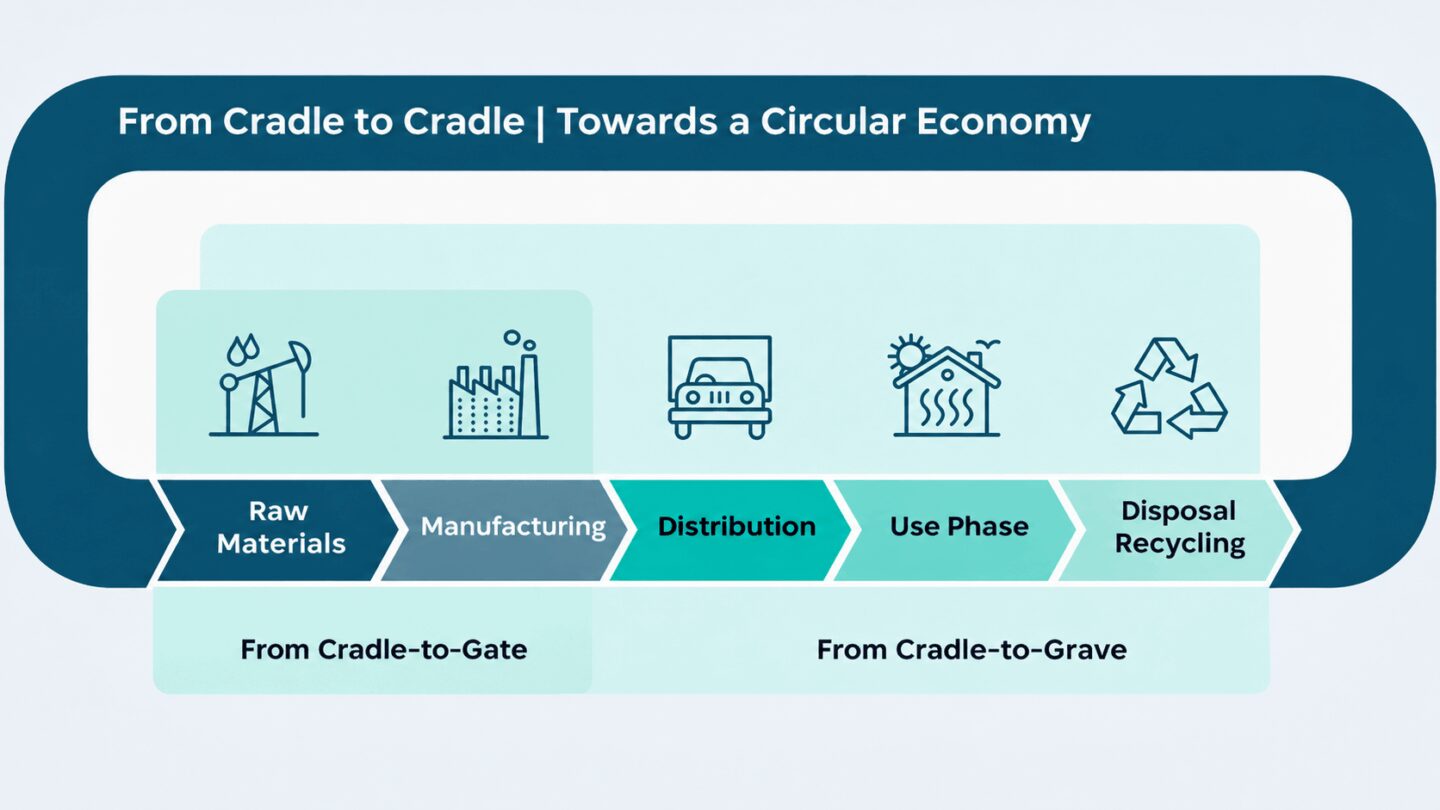
The system boundary defines which life cycle stages a PCF includes: raw material extraction, production, transport, use, and end of life. A cradle-to-gate footprint covers emissions up to the factory gate, which suits business-to-business (B2B) products. A cradle-to-grave footprint adds distribution, use, and disposal, which suits business-to-consumer (B2C) products.
Cradle-to-gate PCFs are the building blocks of the supply chain. Suppliers calculate the footprint of a material or component up to their factory gate and share it with customers, who add their own production emissions. Supplier PCFs therefore make up the upstream part of every cradle-to-grave footprint. Buyers therefore ask for primary data and require the same system boundary, method, and declared unit.
Primary data comes from process-specific measurements and suppliers, such as energy use in a plant or a supplier’s own PCF. Secondary data fills gaps with life cycle inventory databases such as ecoinvent, cm.chemicals, BAFU, or the U.S. Life Cycle Inventory (USLCI) database. The more primary data a PCF uses, the more accurate and credible the result.
Each emission is multiplied by its global warming potential (GWP), usually based on values from the Intergovernmental Panel on Climate Change (IPCC), to express the total climate impact in CO2e. The GWP compares the warming effect of a gas with that of carbon dioxide over a fixed period, and most standards use 100 years. Methane, for example, warms the climate far more strongly per ton than CO2, so a PCF can add up different gases in one result.
The automotive industry is building a shared system for PCF data. A vehicle contains thousands of parts from multi-tier supply chains, so carmakers rely on cradle-to-gate PCFs from their suppliers to calculate the footprint of the finished vehicle. Two systems matter most: Catena-X, which defines how PCF values are calculated and exchanged, and the International Material Data System (IMDS), which can carry them alongside material data.
Catena-X is a data ecosystem of the automotive industry for exchanging data between companies along the supply chain. Its Product Carbon Footprint Rulebook defines one common method for calculating PCFs and uses a cradle-to-gate system boundary for components and vehicles. Companies exchange the values through standardized interfaces. The Together for Sustainability initiative and Catena-X also developed a framework for verifying and certifying PCF values.
IMDS is the automotive industry’s system for reporting the material composition of parts. Since release 15 in 2025, suppliers can add product carbon footprint and transport carbon footprint data to each material data sheet (MDS) and pass it to their customers. This reporting is voluntary and agreed between business partners, and IMDS does not calculate the PCF itself. The data fields follow the Catena-X PCF rulebook, which the IMDS Steering Committee and supplier associations from North America, Europe, and Japan chose as the common basis. Companies that calculate PCFs according to the rulebook can therefore report them in IMDS.
Get expert insights on product carbon footprints from Assent’s team of experts.
The answers cover the product carbon footprint definition, calculation, standards such as ISO 14067, and supplier data exchange through IMDS and Catena-X.
Explore more on sustainability and carbon footprinting by our experts.

Understand scope 1, 2 and 3 emissions, including definitions, examples, how to measure them, and reduction strategies.

What is a Product Carbon Footprint (PCF)? Learn how to calculate product emissions, apply ISO 14067, and use PCF data across automotive supply chains.

A corporate carbon footprint (CCF) shows how much greenhouse gas a company emits through its operations, energy use, and value chain. Learn how companies measur …

Learn what life cycle assessment (LCA) is: its definition, four phases, data needs, and impact categories under ISO 14040/44.

What is an Environmental Product Declaration (EPD)? Learn about EPD standards, life cycle assessments, product category rules, verification, and benefits.

