Scope 3 reporting is no longer optional. Under the Corporate Sustainability Reporting Directive (CSRD), you must account for indirect emissions across your entire value chain, from supplier operations upstream to product use and disposal downstream.
Scope 3 is complex, data-intensive, and essential for credible sustainability performance. This article unpacks what CSRD Scope 3 reporting requires and how you can turn compliance pressure into strategic advantage.
CSRD Scope 3: Key Facts at a Glance
- Requirement: The CSRD requires you to report Scope 1, 2 and 3 emissions, including indirect value chain emissions wherever Scope 3 is material.
- Framework: Reporting follows the Greenhouse Gas (GHG) Protocol and the European Sustainability Reporting Standards (ESRS), especially ESRS E1 Climate Change, and your disclosures must be audit-ready.
- Categories: The GHG Protocol defines 15 Scope 3 categories across upstream and downstream activities.
- Scope of application: Since Omnibus I, the CSRD applies to companies with more than 1,000 employees and more than €450 million net turnover.
- Challenge: Data gaps in multi-tier supply chains make Scope 3 the most material and most difficult part of your corporate carbon footprint.
CSRD Basics: How Scope 1, 2 and 3 Fit Together
The CSRD significantly raises the bar for sustainability disclosures in the EU. It replaces and expands the previous Non-Financial Reporting Directive (NFRD) and shifts from high-level narrative reports to detailed, standardized metrics across environmental, social, and governance (ESG) topics.
At its core, the CSRD requires you to report climate-related impacts across Scope 1, 2 and 3 emissions, including indirect value chain emissions. That marks the move from voluntary carbon tracking to mandatory, audit-ready reporting. The directive builds on the European Sustainability Reporting Standards (ESRS), a unified framework for structuring and validating disclosures across industries.
Which Companies Must Comply With the CSRD?
The Omnibus I Directive, which the Council of the EU finally approved in February 2026, narrowed the scope of the CSRD. You now fall under the directive if you meet both of these criteria:
- More than 1,000 employees (average over the financial year)
- A net turnover of more than €450 million
The change removes many medium-sized enterprises from the reporting obligation. For fiscal years 2025 and 2026, Member States may also exempt companies that stay below the new thresholds.
New Timeline and Phased Implementation
The CSRD remains active EU law, but the Omnibus I Directive postponed and phased some reporting obligations to reduce administrative burden and give you time to prepare. The timeline now looks like this:
- Fiscal years 2025–2026: Large listed companies already subject to the NFRD report first (reports for fiscal year 2025 are due in 2026).
- Fiscal year 2027: Other companies above the new thresholds follow (reports are due in 2028).
- Fiscal year 2028: Non-EU groups with more than €450 million turnover in the EU start reporting, provided they have an EU subsidiary or branch above €200 million.
Sector-specific standards have been deferred, and simplified reporting applies to certain cross-border or non-EU entities. Scope 3 reporting remains mandatory wherever these emissions are material, regardless of sector or location. The revised, shorter ESRS that the European Commission adopted in July 2026 cut mandatory datapoints by more than 60%, but they keep the Scope 3 requirement.
What Scope 3 Covers: Beyond Company Borders
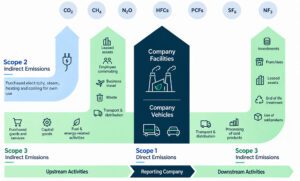
Scope 3 covers all indirect greenhouse gas (GHG) emissions that occur outside your direct control but within your value chain. The Greenhouse Gas Protocol, which underpins the CSRD’s reporting logic, defines 15 Scope 3 categories across upstream and downstream activities. These examples show the difference:
| Upstream Examples | Downstream Examples |
|---|---|
| Purchased goods and services | Product use and energy consumption |
| Capital goods and inbound logistics | Distribution and franchises |
| Business travel and waste from operations | End-of-life treatment and disposal |
Scope 3 often holds the largest emission sources, especially in sectors like manufacturing, automotive, or consumer goods. Scope 1 and 2 emissions are easier to quantify, while CSRD Scope 3 reporting requires data from suppliers, customers, and recyclers. That makes Scope 3 both the most material and the most difficult part of your corporate carbon footprint.
CSRD Scope 3 Requirements: From Expectation to Obligation
Under the CSRD, Scope 3 reporting shifts from voluntary best practice to binding requirement. You must disclose all relevant value chain emissions, using the Greenhouse Gas Protocol as the methodological foundation and aligning with the ESRS, especially ESRS E1 Climate Change. Core requirements include:
- Quantification: Complete quantification of all material Scope 3 categories
- Exclusions: Justification for exclusions, backed by transparent reasoning
- Targets: Emission reduction targets that include Scope 1, 2 and 3
- Data quality: Data quality assessments and updates on improvement actions
- Suppliers: Supplier engagement strategies to close information gaps
These disclosures must be audit-ready and follow the principle of double materiality. They show not only how climate affects your company, but also how your company contributes to climate change.
CSRD Solution
See how Assent helps you calculate, validate, and report Scope 3 emissions:
- Calculate Product and Corporate Carbon Footprints in line with the GHG Protocol and ISO standards
- Collect and validate supplier data to close gaps in your upstream and downstream figures
- Identify emission hotspots and set reduction priorities
Why Scope 3 Is Challenging: Data Gaps and Supply Chain Blind Spots
When it comes to CSRD Scope 3 compliance, calculation methods are only part of the equation. The real challenge lies in putting them into practice across fragmented, global value chains. Key friction points include:
- Data availability: Many suppliers lack digital systems or are reluctant to share emission data.
- Data quality: Estimates and industry averages still dominate, undermining audit readiness.
- Complexity: Multi-tier supply chains with thousands of inputs make tracing emissions a logistical burden.
- Control: Companies often have little leverage over downstream actors or product use phases.
Even large corporations find it difficult to gather consistent upstream figures, especially from small and medium-sized enterprises (SMEs) or non-EU suppliers. Validating and consolidating that data into a single, CSRD-compliant Scope 3 footprint is a major operational task. Regulators expect transparency over data limitations, but not excuses: show how you deal with gaps, engage partners, and improve year over year.
How to Get Ready: Building a Scalable Scope 3 Strategy
Start CSRD-aligned Scope 3 reporting with a structured readiness roadmap. Piecemeal efforts won’t scale, so you need systems that grow with regulatory demands. Follow these steps to move from theory to action:
- Run a Scope 3 screening: Map out all 15 categories, identify hotspots, and define what’s material.
- Prioritize supplier engagement: Start with strategic suppliers in high-impact categories.
- Choose the right tools: Use digital platforms that support emission calculation, data validation, and workflow integration.
- Document methodologies: Ensure traceability of assumptions, data sources, and boundary decisions.
- Track progress: Build in review cycles to assess improvements in data quality and coverage.
Smart companies combine digital infrastructure with governance: they assign internal roles, set milestones, and invest in training. That’s how compliance becomes a driver of operational resilience and transparency.
How Assent Supports Your CSRD Scope 3 Reporting
Managing Scope 3 emissions takes more than data collection. You need carbon accounting, life cycle assessment, and supply chain transparency working together. Assent helps you calculate Product Carbon Footprints (PCF) and Corporate Carbon Footprints (CCF) in line with ISO 14064, ISO 14067, PAS 2050, and the GHG Protocol, and pinpoint emission hotspots. Supplier data collection closes gaps across your upstream and downstream activities, while life cycle assessment extends your view across the entire product life cycle.
FAQ: CSRD Scope 3
Get answers to your questions about CSRD Scope 3 from our experts.
This information is provided for educational purposes only and does not constitute legal or regulatory advice. The information is current as of the date of publication or send. Your organization remains responsible for confirming compliance obligations.