

Still Exploring?
Looks like you’ve been exploring our platform.
Want to see everything in one place?

EPD stands for environmental product declaration, a standardized document reporting a product’s or service’s environmental performance based on life cycle data. It covers potential environmental impacts from raw materials and manufacturing to transportation, use, and end-of-life treatment, depending on the defined system boundaries.
An EPD presents life cycle assessment (LCA) results in a consistent, independently verified format following international standards and product-specific rules.
As Type III environmental declarations, EPDs provide transparent environmental information without rating products or certifying them as environmentally friendly.
A life cycle assessment (LCA) measures a product’s potential environmental impacts, while an EPD communicates selected results in a standardized, verified declaration.
Companies use LCAs to compare product designs, identify environmental hotspots, and evaluate alternative materials. EPDs make this environmental data accessible to customers, procurement teams, and other stakeholders.
Not every LCA qualifies for an EPD. The assessment must meet applicable product category rules (PCRs) and programme requirements.
International standards define how EPDs are developed, verified, and published, ensuring consistent methodologies across industries and product categories.
ISO 14025 is the principal international standard for EPDs. Its 2026 edition defines requirements for EPD programmes, life cycle information, verification, and programme governance. It builds on the broader ISO 14020 framework for environmental statements and programmes.
ISO 14040 and ISO 14044 define the principles and methodological requirements for the underlying LCA, covering goal and scope definition, life cycle inventory, impact assessment, and interpretation.
EN 15804 establishes core product category rules for construction products in Europe. Its A2 amendment specifies environmental indicators, reporting requirements, and life cycle modules.
ISO 21930 provides related international requirements for construction product EPDs. The applicable standards depend on the product category, market, and EPD programme.
Product Category Rules (PCRs) define how environmental impacts must be calculated and reported for a specific product category. They complement international EPD standards and improve consistency across manufacturers.
What do Product Category Rules define:
Using the same PCR improves consistency, but reliable product comparisons still require equivalent functions, compatible methodologies, and system boundaries.
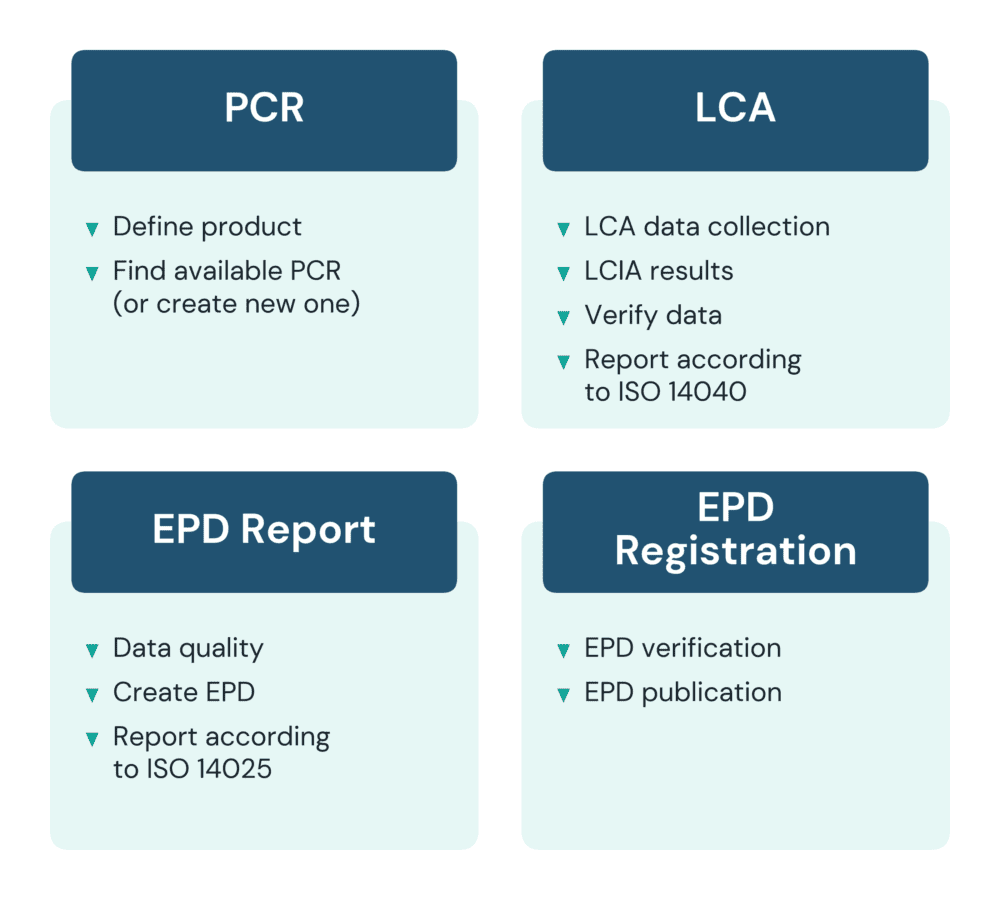
Creating an EPD involves four steps, from selecting product category rules to publishing the verified declaration.
Identify a valid PCR for the product or service through an EPD programme operator’s PCR library. If none exists, new rules may need to be developed or suitable existing rules adopted. The PCR establishes the requirements for the subsequent assessment.
Conduct an LCA following ISO 14040, ISO 14044, and the applicable PCR:
Compile the LCA results into the required EPD format, including product information, manufacturer details, methodology, and data sources.
Document the declared or functional unit, system boundaries, environmental impact results, assumptions, and limitations. EPD programme operators may provide standardized templates or digital reporting systems.
The EPD undergoes independent verification through an approved route to confirm data quality, methodological consistency, and compliance with the PCR and programme requirements.
Once verified, an EPD programme operator, such as the International EPD System registers and publishes the declaration with a registration number and defined validity period.
An EPD presents independently verified environmental data for a specific product or product group. Based on a life cycle assessment (LCA), it typically reports indicators such as global warming potential, resource use, water-related impacts, and waste generation.
It also identifies the product, calculation methodology, declared or functional unit, and life cycle stages included. For construction products, these stages are often structured into modules covering manufacturing, installation, use, and end of life.
This standardized format helps customers understand where environmental impacts arise and which data can inform purchasing or project assessments.
Before publication, an EPD is verified through an approved independent verification route and registered with a programme operator. EPDs are typically valid for five years, although changes in production, materials, or underlying data may require earlier updates.
Verification confirms that the declaration meets the applicable rules; it does not certify that a product is environmentally friendly. Likewise, two EPDs are not automatically comparable. Buyers must consider equivalent product functions, product category rules (PCRs), system boundaries, and calculation methods before drawing conclusions or selecting one product over another.
EPDs help manufacturers communicate reliable environmental data to customers, meet procurement requirements, and improve transparency across supply chains.
Get expert insights on environmental product declarations from Assent’s team of experts..
The answers cover EPD definitions, standards, verification, validity, and the relationship between EPDs and life cycle assessments.
Get more insights on Product Sustainability from our experts.

Understand scope 1, 2 and 3 emissions, including definitions, examples, how to measure them, and reduction strategies.

What is a Product Carbon Footprint (PCF)? Learn how to calculate product emissions, apply ISO 14067, and use PCF data across automotive supply chains.

Learn what life cycle assessment (LCA) is: its definition, four phases, data needs, and impact categories under ISO 14040/44.

