

Still Exploring?
Looks like you’ve been exploring our platform.
Want to see everything in one place?

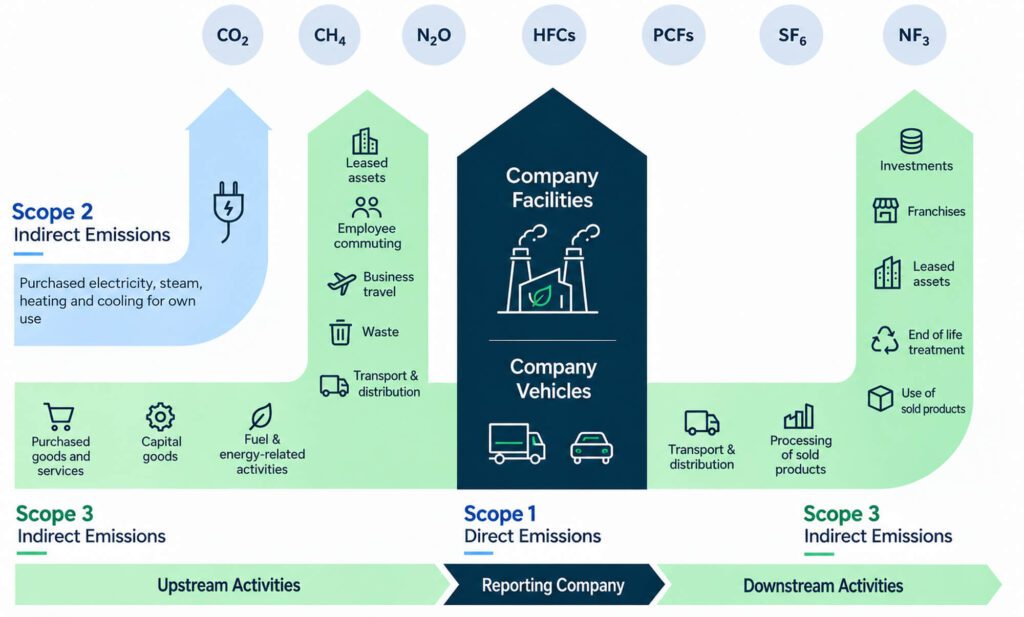
The Scope 1, 2 and 3 framework is central to calculating a company’s Corporate Carbon Footprint (CCF), which measures greenhouse gas (GHG) emissions associated with its operations and value chain. Defined by the GHG Protocol, the three scopes distinguish between direct emissions, emissions from purchased energy, and other indirect emissions across the value chain. Reporting frameworks such as the Corporate Sustainability Reporting Directive (CSRD), the UK’s Streamlined Energy and Carbon Reporting (SECR), and other standards worldwide build on this approach, although their disclosure requirements differ.
The scope concept originates from the GHG Protocol’s Corporate Accounting and Reporting Standard, developed by the World Resources Institute (WRI) and the World Business Council for Sustainable Development (WBCSD). First released in 2001 and revised in 2004, it established a common, internationally recognized method for companies to measure, manage, and report their GHG emissions.
By classifying direct and indirect emissions into three scopes, the framework helps prevent double counting within a company’s GHG inventory and provides a consistent basis for regulatory reporting, voluntary initiatives, and assurance. Today, it also supports climate target setting, including science-based targets.
Scope 1 covers the emissions a company causes directly, while Scope 2 covers the emissions behind the energy it buys.
Scope 1 emissions are direct GHG emissions from sources that a company owns or controls. They arise from activities where the organization directly burns fuel or releases greenhouse gases. Typical sources include:
Because Scope 1 emissions are under direct operational control, they are often easier to measure and reduce through efficiency improvements, fuel switching, or process optimization.
Scope 2 emissions are indirect GHG emissions from the generation of purchased or acquired electricity, steam, heating, or cooling that a company consumes. They occur at the energy supplier’s facilities, but the company’s demand for energy drives them. Key characteristics include:
Examples include electricity for production lines and data centers, district heating for offices, or imported steam for industrial processes. Reductions usually combine efficiency measures with a shift to low-carbon or renewable energy.
Scope 3 emissions cover all other indirect GHG emissions that occur in a company’s value chain, outside its direct control but linked to its activities. This includes both upstream impacts (suppliers and inbound logistics) and downstream impacts (customers, distribution, and end-of-life).
For many sectors, Scope 3 emissions represent the majority of the carbon footprint, often between 70 and 90%. They include, for example:
To structure these value chain emissions, the GHG Protocol defines 15 Scope 3 categories, grouped into eight upstream and seven downstream categories. Together, they show how products and services create emissions before, during, and after they leave a company’s facilities. Because Scope 3 emissions depend on supplier data, product design, and customer behavior, they are the most challenging to measure, but they also offer the biggest levers for meaningful climate action.
Measuring emissions across all three scopes turns the framework into numbers that people can act on. The following sections explain why complete coverage matters and how the calculation works.
Measuring only direct emissions no longer reflects how regulators, investors, and customers view climate risk. For any organization pursuing net zero, a complete carbon footprint across Scope 1, 2 and 3 is the starting point: it helps identify hotspots, prioritize reduction measures, and show that a climate strategy rests on robust data rather than estimates. A complete approach delivers:
Corporate carbon footprints and carbon accounting across all three scopes typically follows five steps:
Once companies have quantified their Scope 1, 2 and 3 emissions, the next step is targeted reduction. The measures differ by scope:
A credible decarbonization roadmap combines reduction measures across all scopes and links them to clear targets, budgets, and responsibilities.
Get expert insights on Scope 1, 2 and 3 emissions from Assent’s team of regulatory experts.
Explore more resources on carbon accounting, Scope 3 emissions, and CSRD reporting.
Understand scope 1, 2 and 3 emissions, including definitions, examples, how to measure them, and reduction strategies.

What is a Product Carbon Footprint (PCF)? Learn how to calculate product emissions, apply ISO 14067, and use PCF data across automotive supply chains.
A corporate carbon footprint (CCF) shows how much greenhouse gas a company emits through its operations, energy use, and value chain. Learn how companies measur …

