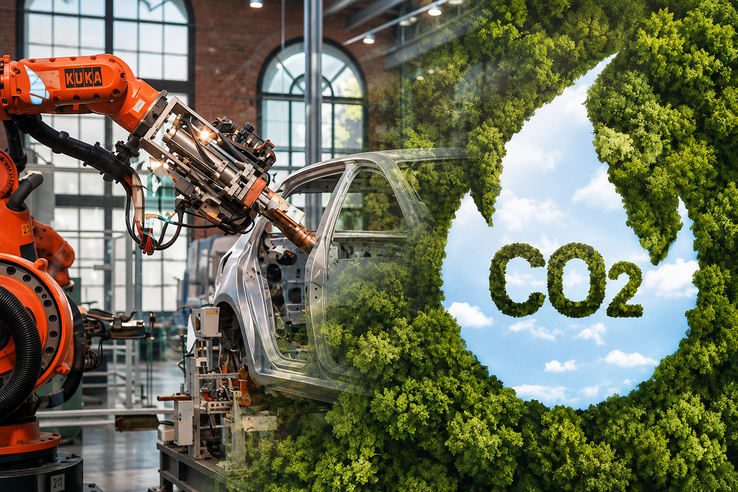
Sustainability puts the transport sector, and the automotive industry in particular, under close scrutiny. Concern about climate change has moved sustainability, Environmental, Social, and Governance (ESG) criteria, and Corporate Social Responsibility (CSR) to the center of the industry’s agenda. For OEMs, measuring and reducing the carbon footprint on the way to net zero is no longer a choice but an imperative.
Sustainability in the Automotive Industry: Key Facts at a Glance
- CO2 Impact: The automotive industry is one of the largest contributors to global CO2 emissions, which makes sustainability a strategic imperative for every OEM rather than an optional add-on.
- Challenges: The biggest challenges include supply chain complexity, carbon emissions, end-of-life vehicle management, and balancing eco-friendly practices with cost efficiency.
- Trends: Key trends driving change are the electric vehicle revolution, circular economy practices, carbon-neutral manufacturing commitments, and digital transformation.
- Targets: Leading automakers, including Volkswagen, Volvo, and Ford, have set carbon neutrality targets ranging from 2035 to 2050.
- Software: Integrated software that combines product compliance, life cycle assessment (LCA), and carbon footprint data is essential to manage sustainability at scale across complex supply chains.
Eight Challenges for Sustainability in the Automotive Industry
The destination is clear: sustainable automotive practices. The path to get there involves challenges that call for innovative solutions from car manufacturers.
Strategy, Cost, and Consumer Expectations
Sustainability is not a one-time endeavor but a journey that demands continuous commitment. Car manufacturers plan for long-term viability while adapting to changing consumer preferences, technological advances, and regulatory changes. A holistic approach that considers economic, environmental, and social factors helps them meet this challenge.
The trade-off between sustainable practices and cost efficiency is another balancing act. Eco-friendly initiatives often come with an initial price tag, and customers must still be able to afford sustainably produced cars. Sustainability and cost efficiency do not have to contradict each other, though: companies and customers can both benefit economically from more sustainable products, for example through savings in energy and material consumption.
Consumers are more environmentally conscious than ever, so manufacturers need to align their sustainability goals with consumer expectations and communicate their efforts effectively. Transparency about sustainability initiatives builds trust and loyalty and helps consumers feel confident in their choice of environmentally friendly vehicles.
Compliance, Supply Chains, and Data
In an era of tightening environmental regulations, compliance in the automotive industry matters more than ever. Car manufacturers navigate an evolving landscape of standards and balance the need for compliance with the drive for innovation, so that new, sustainably produced vehicles reach the market successfully.
Automotive supply chains add another layer. From raw material extraction to final assembly, the chain offers many opportunities for improvement, and OEMs work with intricate webs of suppliers that each have their own environmental impact. A more sustainable end-to-end process starts with understanding that web.
Data availability and quality matter just as much. Supply chains span multiple tiers of suppliers and a wide range of materials and components sourced worldwide. Gathering data on the environmental impact of each component, from raw material extraction and manufacturing to transportation and end-of-life disposal, is difficult without transparency and standardized reporting across the supply chain.
End of Life and Carbon Emissions
The lifespan of a car extends beyond its time on the road, and the disposal of end-of-life vehicles remains a major challenge. Sustainable practices must cover the recycling and responsible disposal of components, such as the interior, so that the environmental impact of the entire vehicle life cycle stays as low as possible.
One of the automotive industry’s biggest environmental challenges is reducing the carbon footprint of vehicles, from car manufacturing to everyday use. Traditional manufacturing processes that rely on fossil fuels contribute significantly to greenhouse gas emissions, and production can also release air pollutants such as volatile organic compounds from painting and solvent use.
Overall, the automotive industry causes many environmental impacts, in production and in use, from water consumption, land use, and habitat destruction to air and water pollution.
Eight Sustainability Trends in the Automotive Industry
Several trends address these challenges and shape sustainable car manufacturing. The eight most important ones at a glance:
| Trend | What it means |
|---|---|
| Electric vehicles | Automakers invest heavily in electric models to reduce their dependence on fossil fuels and cut greenhouse gas emissions. As battery technology advances, EVs become more accessible, and over their entire life cycle, electric cars have a lower carbon footprint than combustion-engine cars. |
| Hybrid vehicles | A transitional step toward full electrification: improved fuel efficiency and lower emissions while keeping the convenience of conventional fuel infrastructure. |
| Regenerative braking | Vehicles recover and store energy during deceleration. This improves fuel efficiency in traditional vehicles and raises the overall energy efficiency of electric and hybrid vehicles. |
| Circular economy | Recycling, reusing, and reducing waste throughout the production cycle, from recycled materials in vehicle components to designs that are easier to disassemble for recycling. |
| Sustainable materials | Alternatives such as bio-based plastics, recycled fabrics, and lightweight composites improve fuel efficiency and reduce the environmental impact of production. Smart materials that contribute to energy efficiency are gaining traction. |
| Carbon neutrality | Operations become climate neutral, covering car manufacturing itself, upstream supply chain processes, and downstream phases such as distribution, use, and end of life. Carbon neutrality targets and net-zero ambitions align with global efforts to combat climate change. |
| Shared mobility | Ride sharing and car sharing promote a more efficient use of vehicles and can, at least in theory, reduce the overall number of vehicles on the road, while connectivity enables smart transportation systems. |
| Digital transformation | From smart manufacturing to data-driven supply chain management, digitization improves operational efficiency and reduces the consumption of natural resources. AI, IoT, and digital twins support predictive maintenance, optimize energy usage, and minimize waste. |
IMDS Software
See how Assent’s IMDS software helps OEMs and suppliers manage IMDS material data and PCF data in one system.
- IMDS Data: Use essential compliance and sustainability data from IMDS directly in the platform.
- PCF Data: Bring PCF data into your material data process, in line with IMDS 15.0.
- Automated Data Flows: Reduce manual work between your data sources.
Sustainability Initiatives From Automotive Companies Around the World
Car manufacturers worldwide show with their initiatives how these challenges and trends work in practice.
Volkswagen’s Journey to Sustainability
The Volkswagen Group has invested heavily in electric vehicle technology with its ID series and aims to produce EVs at scale to reduce carbon emissions from transportation. Volkswagen aims to make all of its production sites worldwide net carbon neutral by 2040, with a focus on renewable energy and energy efficiency. Volkswagen was also one of the first car manufacturers to carry out a life cycle assessment for one of its cars, the Golf III, in 1996.
Volvo Cars’ Commitment to Net Zero
Volvo has revised its 2030 electrification goal: it now targets 90–100% electrified cars in global sales, including fully electric and plug-in hybrid models, and remains committed to becoming a fully electric car company. Since 2019, all Volvo models have been available in an electrified version. In 2023, the launch of the EX90, EX30, and EM90 alongside the existing EX40 and EC40 brought the number of fully electric models on the market to five.
Volvo also plans to reach 30% average recycled content across its fleet by 2030, with new car models containing at least 35% recycled content. The company aims to become climate neutral, with net zero greenhouse gas emissions, and a circular business by 2040.
Ford’s Path to Responsible Manufacturing
The Ford Motor Company also pursues sustainability with ambitious goals: complete carbon neutrality by 2050, and in Europe already by 2035. With the Mustang Mach-E, F-150 Lightning, and E-Transit, Ford has shown that a wide variety of vehicle types can be electrified.
Responsible sourcing and human rights matter to Ford as well. It has partnered with the Initiative for Responsible Mining Assurance, the Responsible Supply Chain Initiative, Drive Sustainability, and the Responsible Business Alliance to prioritize environmental and social responsibility across its supply chain.
How Assent Supports Sustainability in the Automotive Industry
Sustainability in the automotive industry depends on precise data, transparent insights, and integrated tools that cover product compliance and sustainability together. Assent helps OEMs and suppliers combine product compliance data with LCA and carbon footprint calculations, so cross-functional teams work with consistent, reliable data from the product to the corporate carbon footprint. This lets you automate PCF and LCA calculations, map production data to environmental data, and connect material information from IMDS and bills of materials (BOMs). Embedded in your existing workflows, this enables faster, data-driven sustainability decisions.
FAQ: Sustainability in the Automotive Industry
Get answers to your questions about sustainability in the automotive industry from our experts.
This information is provided for educational purposes only and does not constitute legal or regulatory advice. The information is current as of the date of publication or send. Your organization remains responsible for confirming compliance obligations.