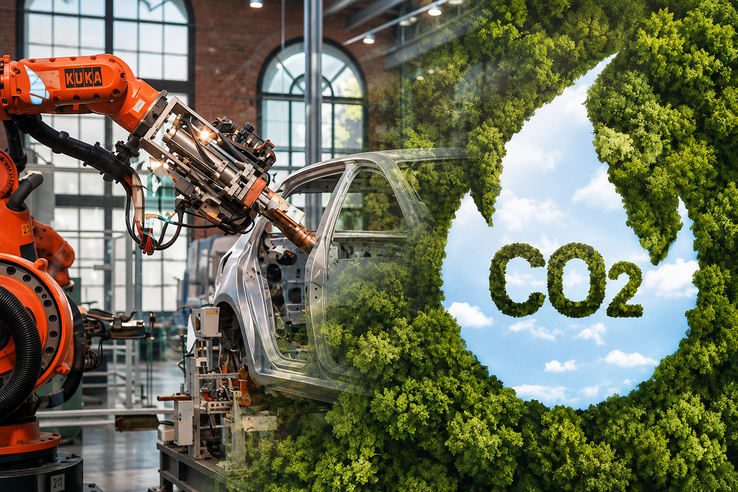
Transport causes more than a quarter of the EU’s greenhouse gas emissions, according to the European Environment Agency, and around 70% of that comes from road transport. Vehicle use produces the largest share, but manufacturing offers room for cuts too, and OEMs already push carbon reduction into their supply chains. So how can you reduce the carbon footprint of car manufacturing?
Carbon Footprint of Car Manufacturing: Key Facts at a Glance
- Transport: Transport causes more than a quarter of EU greenhouse gas (GHG) emissions, and around 70% of that comes from road transport, so the full vehicle lifecycle matters.
- Manufacturing: Manufacturing contributes 20–30% of a car’s lifecycle emissions, with steel, aluminum, plastics, and battery production as the key hotspots.
- CO2 per Vehicle: Producing an average ICE vehicle generates around 5.6 metric tons of CO2, while a battery electric vehicle (BEV) emits about 8.8 metric tons but offsets this in the use phase.
- Break-Even: BEVs break even with ICE vehicles in lifecycle emissions after roughly 60,000–80,000 km, well within a typical vehicle lifespan.
- Data Exchange: IMDS 15 enables standardized Product Carbon Footprint (PCF) data exchange across the automotive supply chain, aligned with the Catena-X PCF Rulebook.
OEM vs. Supplier Perspectives in Carbon Footprinting
Scopes and system boundaries for a product carbon footprint in the automotive industry differ significantly between OEMs and suppliers. The difference stems from their roles and responsibilities in the supply chain and from their sustainability priorities.
| Supplier perspective | OEM perspective | |
|---|---|---|
| Approach | Cradle to gate | Cradle to grave |
| Who | Tier 1 and Tier 2 suppliers | OEMs assessing the CO2 footprint of their vehicles |
| Scope | Manufacturing processes, including raw material sourcing, up to delivery to the OEM | Entire life cycle: raw material extraction, manufacturing, use, and end of life |
| Drivers and limits | OEM requirements and contracts often drive this approach and may specify assessments up to the gate | Limited data availability and comparability make the use phase and end of life harder to include |
Collaboration Opportunities: OEMs and suppliers work with different scopes, but alignment helps ensure transparency and consistency across the supply chain. When each side understands the other’s perspective and priorities, automakers and suppliers can identify opportunities to reduce carbon emissions and improve resource efficiency throughout the supply chain.
Industry standards and best practices for carbon footprinting support consistent methodologies and data sharing among OEMs and suppliers. This fosters transparency, trust, and collective action toward sustainability goals across the automotive sector.
How Do BEV and ICEV Carbon Footprints Compare?
Comparing the environmental impact of battery electric vehicles (BEVs) and internal combustion engine vehicles (ICEVs) is difficult because materials, production processes, and usage patterns differ. Still, studies indicate that BEVs offer significant environmental benefits over ICEVs, particularly in GHG reduction.
The phases compare as follows:
| Phase | BEV compared with ICEV |
|---|---|
| Raw materials and production | Higher carbon footprint, mainly because of battery production |
| Use phase | Significantly lower emissions, especially with renewable energy |
| Break-even point | At 60,000–80,000 km for mid-sized vehicles, within a car’s typical lifespan (source: Cotes) |
| Over the lifetime | Lower emissions offset the initial footprint of battery production, so electric cars have a lower carbon footprint overall |
Proper end-of-life handling is crucial to maximize the environmental benefits of BEVs. Recycling and repurposing battery materials minimize waste and reduce the footprint of disposal, and effective recycling programs and secondary-use applications for retired batteries extend their lifespan and support a more sustainable battery supply chain.
Carbon Emission Hotspots in Car Manufacturing
Most people think of fuel consumption and tailpipe emissions when they consider a car’s climate impact, and studies often highlight the contribution of vehicle operation. To understand a car’s full environmental impact, though, you also need to consider its entire life cycle, including raw materials and manufacturing.
Climate Impact of Steel
Steel is fundamental to automotive manufacturing thanks to its strength, durability, and versatility, but its production and use contribute significantly to carbon emissions across the vehicle lifecycle.
Steel production is energy-intensive, particularly in the raw material phase. Smelting or melting iron ore requires large amounts of energy, mainly from fossil fuels, and pressing, stamping, and molding steel components also consume considerable energy. The high density and weight of steel add emissions during transport and assembly.
You can mitigate the climate impact of steel in several ways: use more recycled steel to limit energy-intensive raw material production, power steel production with renewable sources such as solar and wind energy, and move toward hydrogen-based steel production.
Climate Impact of Aluminum
Aluminum is widely used in the automotive industry because its light weight improves fuel efficiency and reduces emissions during vehicle operation. Its production, however, is energy-intensive, which raises GHG emissions.
Aluminum recycling and closed-loop systems are a key strategy to reduce its carbon footprint, since recycling requires significantly less energy than primary production and results in lower emissions.
Advanced technologies such as prebake and inert anode smelting can improve energy efficiency and reduce the global warming potential of aluminum production. Integrating renewable energy sources such as hydropower or solar energy into the smelting process mitigates the environmental impact further.
Climate Impact of Plastics
Alongside metals, plastics play a vital role in car manufacturing, offering versatility, durability, and design flexibility. Their production and use contribute to GHG emissions, primarily through energy-intensive processes such as polymer production and injection molding.
To reduce the environmental impact of plastics in the automotive sector, automakers can focus on bioplastics, renewable materials, energy efficiency, and recycling within a circular economy model.
Scale Life Cycle Assessment Across Your Automotive Portfolio
Answer customer product carbon footprint requests with the material data you already report, then automate up to 80% of life cycle assessment work as your portfolio grows.
How Can You Reduce the Carbon Footprint of Car Manufacturing?
You can reduce the carbon footprint of car manufacturing at three levels: in the production process, in how you design and engineer the vehicle, and in how thoroughly you assess its environmental impact.
Optimization Strategies in Production
Optimization strategies aim to minimize emissions and improve energy efficiency throughout the production process. Seven levers stand out:
| Lever | What to do |
|---|---|
| Sustainable materials | Incorporate eco-friendly composites, bio-based plastics, and recycled steel and aluminum. |
| Closed-loop systems | Recycle materials like steel, aluminum, and plastics within the manufacturing process to minimize waste and reduce the need for virgin raw materials. |
| Logistics | Streamline intra-company transport with efficient logistics planning, layout optimization, and automation technologies. |
| Energy recovery | Use combined heat and power (CHP) generation systems and the waste heat from power generation. |
| Painting | Apply advanced painting techniques such as powder coating, water-based paints, and UV-curing processes. |
| Equipment | Implement energy-efficient equipment, upgrade production technologies, and adopt lean manufacturing principles. |
| Carbon capture | Explore carbon capture and storage (CCS) technologies to keep CO2 emissions from the manufacturing process out of the atmosphere. |
Sustainable Design & Engineering
In addition to creating more climate-friendly production processes, sustainable design and engineering can help to reduce greenhouse gas emissions. The use of recycled and recyclable materials is key. Advances in aerodynamics and lightweight construction improve fuel efficiency and lower emissions during vehicle operation, and electric and hybrid propulsion systems further reduce reliance on fossil fuels, which lowers carbon emissions over the vehicle’s lifecycle.
Beyond Carbon: Comprehensive LCA
GHG emissions and the Product Carbon Footprint (PCF) are significant parts of the total environmental impact, but a comprehensive Life Cycle Assessment (LCA) of car manufacturing must consider a broader range of factors. Air pollution, resource depletion, land use, and water consumption also play crucial roles in assessing the environmental performance of car manufacturing.
Considering these effects helps car manufacturers make more informed decisions about reducing their environmental footprint and conserving natural resources, which contributes to holistic environmental stewardship.
Getting the Data Right: From GWP to IMDS
To conduct PCFs in car manufacturing, you need to collect primary data at hotspots to make informed decisions. OEMs increasingly require suppliers to provide precise data on the global warming potential (GWP) of the materials and components they deliver.
This is where the International Material Data System (IMDS) and suitable software solutions come into play. IMDS is a centralized database that the automotive industry uses to manage and exchange material data for compliance and reporting purposes. Its robust data management makes it a trusted source of comprehensive data for environmental assessments.
IMDS 15 now supports the exchange of standardized PCF information in alignment with the Catena-X PCF Rulebook. OEMs and suppliers can provide and access verified GWP data directly within IMDS, which makes PCF reporting an integrated part of the material data workflow.
How Assent Supports Automotive PCF and IMDS Workflows
Assent helps you put standardized, Catena-X aligned PCF data to work across your supply chain. With Assent, you can retrieve PCF information directly from the IMDS database, and machine learning maps your bills of material (BOM) automatically to PCF and LCA datasets. That streamlines environmental assessments while keeping your data accurate and consistent.
FAQ: Carbon Footprint of Car Manufacturing
Get answers to your questions about the carbon footprint of car manufacturing from our experts.
This information is provided for educational purposes only and does not constitute legal or regulatory advice. The information is current as of the date of publication or send. Your organization remains responsible for confirming compliance obligations.